Wednesday, December 2, 2009

Lincoln Legacy


The piece of art I chose today is a mural located in Philadelphia. This mural was created by Josh Sarantitis and it depicts a young African American male, an abolitionist coin and the planks of a slave ship.
The mural is one of the most detailed murals I have ever seen. It presents amazing color balance and contrast and it holds an important message of freedom.
What I enjoy the most in this mural is the fact the planks of the slave ship blend into the stripes of the American flag, making American subconsciously reminisce about the slavery time in the United States. I also enjoy the irregular shape of the "canvas" in which the artist is working on and the background depicting the map of Africa.
I really like this mural due to the detail, precision and message that presents and it is one of the pieces of art that prove that Graffiti is art.

Chuck close is one of the few artists that has been able to push the medium, and his work as he has aged. His persistence, vision, and personal technique amazes me every time I see his work. His self-portraits make you go back and forth. You need to be at a distance not only to see the whole image, but also to have it come into focus. At the same time, you want to get very close to explore and and study his technique. It is mesmerizing to see the few simple forms he uses inside squares and rectangles, and how this shapes can render an image at a distance. You see the little triangles, donuts, circles, a banana-like shape, etc. each surrounded by a square, or a rectangle which forms part of the grid he works with. Up close you also notice that the almost black areas are also made up of these grids and forms. I would like to get better at art to try making a self-portrait like this much like my brother did.

Soldier with a Plumed Cap

Fillippo Napoletano created this etching in the 16th century. I am a sucker for renaissance art, probably due to its lifelike quality. This piece is so innocent and beautiful. The detail in his clothing is amazing. I find it slightly humorous that this piece is so brilliant to look at but you cannot see the face of the soldier. The artist had to have been pretty good at what he does if the figure has no face, just a backside.

Sand Art

http://www.youtube.com/watch?v=vOhf3OvRXKg&feature=related

I chose to add a video today instead of a single image. This type of artwork is truly amazing. Each image she creates could be frozen in time and it would be a beautiful piece of artwork, but instead they keep moving to tell the story of how Germany invaded the Ukraine during WWII. I love how she uses the music to add to the art and uses positive and negative space in her artwork.

bones


do da Vinci

Anatomy Drawings

During his life April 15, 1452 – May 2, 1519

Paper, Ink, and varios others


I enjoy this series of art because it was the first installments of how we know the human body today. He was one of the first artist who actually took and cut up cadavers to make this art. At his time he was a revelutinary for if anyone even saw him try to do this he would have been stoned or killed. This is inspiring of how he took himself and devoted himself to individually take part of the research of the human body. This was for his own self gain yes, but some of his drawings and graphs that he used are still used in some of our own medical books of today. This is why I admire these drawings.

the edits of the school


Rafael

School Of Athens 1509–1510

Fresco 500 cm × 770 cm (200 in × 300 in)


I do enjoy this art for how it was created. As a fresco it is a lot of work to get the detail and simplicity in it. But you can look closely and see full parts of this and see faces and pieces that are so detailed you would not believe it. The fact he even included himself, Donatello, and Leonardo. He made it as if they were all students of this school and had full idealism of what he wanted to show. It is an amazing artwork that has so many hidden meanings that there are thousands of different ideas of what it all means.

American Gothic


American Gothic was painted in 1930 by Grant Wood. It was painted with oil on beaverboard and its dimensions are 74.3 cm by 62.4 cm. Wood painted American Gothic in his studio at 5 Turner Alley, cedar Rapids, Iowa. In addition to being a painter, Grant Wood was a muralist, metal worker, teacher, and interior designer. He made about 40 paintings and 19 lithographs before his death at age 51. The painting was sold to The Art Institute of Chicago for $300 dollars and still remains there to this day. It is part of the Friends of American Art collection at the Institute.

Numero Cinco!

This photo is an untitled work from Robert Mapplethorpe. He is a very controversial artist who uses photography as his art form. He tends to take pictures of nude models, sometimes in very sadomasochistic positions/poses. Although the pictures he had taken might be a little NSFW, I had decided to post this lovely picture of flowers to show the wonderful black and white photos he does.

A lot of his work is very crisp and had a great balance of contrast. This piece caught my eye due to the fragile nature of the semi-wilted flowers on the pillow, which is soft and how the pillow looks like it "caught" them and protected their fall.

Alex Katz created this painting by using simple shapes. His colors are bold and contrasting. The shapes altho simple include such a diverse amount of color that his work doesn't lay flat. The amount of different colors lined up next to one another creates a mold to the eye. This paintings would look flat without this technique. Katz's paintings are modern yet still have a distinct calming antique look to them.

I chose this painting by James Christensen. It is called "The Responsible Woman". This painting presents a women who is prepared for anything at anytime. I like how there is so much detail and yet is still relaxing and not too crazy. This is done by the calming colors and lack of movement in the area surrounding the figure. If other pieces are looked at there is a constant similarity between figures and objects placed in Christensen's paintings. He often adds brightly colored fish and his paintings all consist of bright colors and intense details. His paintings are realistic and yet the theme is completely fantasy.

The Audacity of Hopelessness

This mixed media work was created by David Kinsey. Pertaining to the title, you can interpret audacity in two ways: Willingness to take bold risks or rude/disrespectful behavior. I believe the first definition works best for the work. I may be over analyzing this but I view the relatively white background as the hopelessness. The zebras are trying to fight there way out from this sense of hopelessness through the rift they've created. The fighting of the zebras illustrates their willingness to take bold risks to escape the hopelessness. The red-orange emphasizes their struggle and the battle they are in. It also emphasizes the rage of zebras. For example the zebra on the far left has red eyes, which we all associate with a very angry and evil animal or person. I also love the composition of the piece. How the zebras are beginning and ending at random points. It adds to the mayhem. Lastly, I like how they seem to originate from the black and red rift that splits the piece.

Tuesday, December 1, 2009

I chose this self portrait of Irving Penn because it shows distinct personality. Though he is considered to be the father of fashion photography, Penn first aspired to be a painter. After studying in Mexico for a year, he quit and destroyed all of his paintings. He photographed for years for Vogue and was very successful. However, when his wife passed away in 1992, he produced two self portraits. This is the second and contains more emotion than the first. To me, the portrait cries to the heavens, saying, "Why did you take her and when will I see her again?" I can also see him seeing himself slowly dying, as only the top left of his head is portrayed as life-like and the rest is melting away.

Rio Cruzeiro

The art piece I choose today involves deep psychological meaning and it is important to analyze the history behind the artwork before discussing it. The piece of art I chose today does not have a specific author because it involved both renowned artists and local youth as a response to improvement of civil rights and equality in the city of Rio de Janeiro in Brazil. The art piece supervised by Jeroen Koolhaas and Dre Urhahn is called "Rio Cruzeiro" and its located in Vila Cruzeiro, a slum in Rio de Janeiro.

This art piece took 8 months to finish, and it was hard to make due to the dimension of the piece, the enduring long periods of rain,shootings between drug dealers and cops and the police occupation of the slum. This art piece is 2000 square meters and it depicts a river with koi fish fighting the waves.The piece is inspired by traditional Japanese design created by master tattooist Rob Admiraal.
This project was created with the support of Favela Painting, an organization that promotes awareness of the harsh life that slum residents in Brazil face every day.

This project involves great effort by both artists and the residents to create a better life in slums.
What I like about this art piece is the vivid colors and the subliminal message of a flood trying to drown the Koi fish, but they do not give up.This message is an interpretation of the Brazilian government trying to "hide" the cruelty and brutality in slums, but the residents represented as Koi fish demand to be heard, not even if they have to "defeat" the river.
The art piece has a great message and it is one of the most controversial and political art projects in Latin America. This piece is seen as the resistance of the slum residents and the demand of a better life as Brazilian citizens.
This art piece also serves to protect the hill from mudslides during the rainy seasons, therefore this art piece is both practical and beautiful, attributes that in art is usually only achieved through architecture, but the artists made it in a painting format.

For more information about Favela Painting and to see more of their works you can go to http://www.favelapainting.com/ and you can actually donate to help the slum residents or the creation of new art projects.

David

This is one of my favorite pieces of art. The size of this marble sculpture is amazing to have created, standing about 17 ft tall. Unlike previous depictions of David, Michelangelo decided to show David before his battle with Goliath. It represents strength, power, and protection. It its located in Florence, Italy. It symbolizes now the defense of civil liberties in Florence.

Speaking of influence

No, these pictures are not supposed to be the same at all, they are both street scenes at night but if you look at Japanese woodcuts and look at a lot of Van Gogh's work, you will see a similarity, The style that Hiroshige used (Ukiyo-e)was a major influence on Vincent Van Gogh. Yes even way back then in the mid to late 1800's people and art got around. In 1854 the Kanegawa treaty opened the doors to Japan and all things Japanese flooded Europe. In 1867 the Pairs Exposition Universelle had a Japan booth and the Parisians and Artists flooded it. Everything "Japan" was now the hottest fashion. Claude Monet even did a painting of his wife in a kimono called "La Japonaise". Van Gogh was quick to buy some prints.

Hiroshige

Van Gogh


I was just googling paintings and this came up. It's kind of weird but really cool at the same time. It just shows that you don't only have to paint on canvas or paper. I really enjoy all of the detail in the trees. All of the colorful leaves and tiny branches then the tiny road leading to the tiny house. It is really amazing how this was done. You can tell this was really thought out before being placed on her face because everything works so well together, and fits perfectly. I really want to watch someone do this to someones face. It would be so interesting to see how long it takes and the process.

Artists inspire artists

Often, artists look to other artists for inspiration and ideas. Sometimes the influence can be seen and sometimes not. Sometimes it is not just a subtle influence but a downright copy with subtle changes for their own personal taste. Here is an image by Hiroshige, Evening Shower at Atake and the Great Bridge, from the series "100 famous views of Edo". A woodblock print from around 1856-8


Here is a painting that Vincent Van Gogh did called Bridge in the Rain, in 1887


Here is an image I did after the Van Gogh piece. I used a combination of techniques on this image including 3D modeling for the bridge and umbrellas, digital Paint and paint synthesis and it all started out as a Massonite and white glue collagraph that was scanned. Yes the pseudo Japanese writing around the border is totally gibberish and probably says that my cat ate my underwear. I don't know if the writing in the Van Gogh piece is fake or real, Any translators out there?


Monday, November 30, 2009

"Beyond The Night."

I was bored one day so I decided to look up abstract art for sale on ebay that I might be able to buy for cheap. It is called "Beyond the Night" and was created by Sergio Lazo. It was one of the first pieces that caught my eye. I will admit I'm partial to black and white works of art. I think it looks better and I think color sometimes takes away from a work. The rendering of the guitar is great. I find Sergio's obsession of guitars a little odd but he makes some great pieces of art. What I like most about it is the background. The geometric shapes are subtle but provide a better background then a flat background. It also alludes to a cityscape which I'm partial to. The touch of red, although somewhat random, completes this piece. The color draws your eyes across the piece and also, at least for me, makes the background become more visible to the viewer. If it wasn't for the $1,700 price tag, I'd buy it.


The painting I choose today was created by Julio Quaresma,one of my favorites artists of all time.Julio Quaresma was born in Angola in 1958.He is one of the most accomplished Portuguese speaking painters.
This Painting denominated Palacio da Pena depicts an abstract image using a style that the artist calls it A Pintura Espiritual Portuguesa( The Portuguese Spiritual Painting). This painting depicts human parts torn apart from a body located in a port situated in the middle of the desert. This piece of art was inspired by Dali surrealism style and it is a manifestation against the racism and separatism existent among Portuguese speaking countries.
I think the artist did an amazing job and I really enjoy the dynamics,the metamorphoses and the separation of roles existent in the painting, such as the floor at the port bleeding and the human arm morphing into nature shapes like tree branches.
I also like the complexity existent in both foreground and background, and how the entire painting contains secret messages that only the people that understand the separatism existent in the Portuguese countries are able to decipher. The contrast and similarities within the painting creates both confusion and insight and it makes this painting resemble like a puzzle.

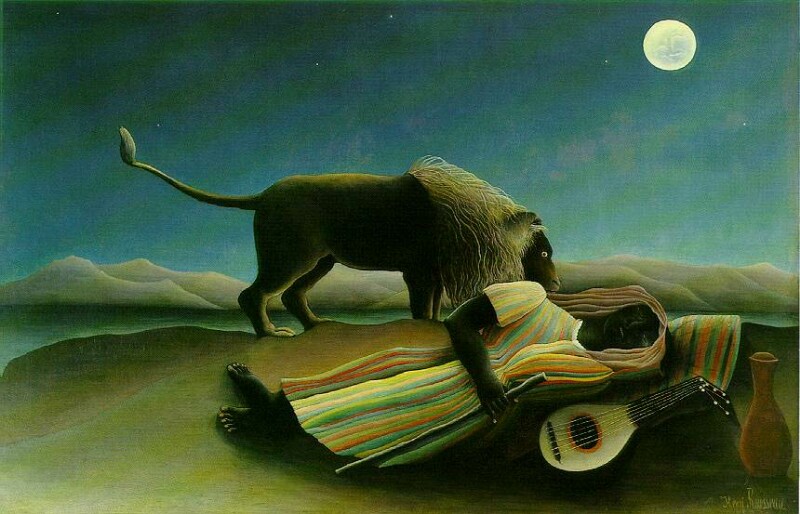
Henri Rousseau


A few years ago, I learned that Rousseau was a complete "amateur artist." I don't really know how anyone can be a "professional artist" anyhow, but Henri never really touched a paintbrush until the middle of his life. He lived a pretty ordinary life (He was a toll collector or something!) How cool is that? (That is not to say that I think toll booth workers are dull, only that it's a very defined, instructionalized career... whereas I think the arts are the opposite of having a career, with little or no definite end points and no rules.) What a turnaround.

Anyway, I'm a super picky poster buyer, but Henri Rousseau's "Sleeping Gypsy" made it on my wall. It's one of the few paintings in which Rousseau depicts a desert landscape, as opposed to his regular lush jungle scenes. A gypsy sleeps happily while a roaming lion curiously sniffs her/him. The gypsy is androgynous and not eroticized which emphasizes the mood instead of the individualized character. I love how the gypsy's feet upon close inspection, appear to be inflated like balloons.